Friday, July 22, 2011

The Triumph Playlist

" 'You're not punk, and I'm telling everyone!'
Save your breath, I never was one!
You don't know what I'm all about,
like killing cops and reading Kerouac"

--Jawbreaker, "Boxcar"

Up at the top of this blog, there's a mission statement that says "punk-rock literary criticism." And I wanna talk about that now. I could talk about the critics who inspire me (Marx, Koestler, Foucault, Said, Zizeck, Bakhtin, Butler, Fish), but I know what you're thinking: "another blog about Mikhail Bakhtin's theory of the groteqsue and Foucault's theories of power and authority? Like that's never been done before!" Also, it would be hard work. So let's talk about the punk thing instead.

If you've read, like, any of this blog, you may have noticed that music is kind of a big deal in what I do. It's usually in the background, but the essential premise of this thing I write is "dude, the literary canon is pretty punk rock." So I was hoping we could talk about that some. Yeah. Let's talk about how much we love rock and roll. We're cool kids. Awesome.

Anyway, all posturing aside, these are 5 bands who I think really represent what the mission statement of this blog is. If you've got any of their stuff, this is what I'd recommend as the best accompaniment to my various rambles and discussions. Also, I'm not finished with Didion's Democracy yet, which is why I'm doing kind of a fluff piece.
Wow, it's like if Chuck Klosterman was even less of a real journalist!

Friday, July 15, 2011

Thoughts on Blood Meridian

"A ritual includes the letting of blood. Rituals which fail in this requirement are but mock rituals."

A few days ago, I finished Cormac McCarthy's Blood Meridian, Or The Evening Redness In The West.

And then I sort of wandered about in a daze for the rest of the day-- the way I did after first watching Apocalypse Now, or hearing Shostakovich's 8th quartet for the first time. It's a book that's emotionally draining the whole way through and then, in the last fifty pages or so, hits you in the gut like a stab wound. It's a serious contender for the greatest American novel of the past thirty years. Maybe fifty. It's the closest thing contemporary literature has to its Heart of Darkness and McCarthy does for the bloody and empty American West what Conrad did for the Congo.

Which is to say, transforms it into a vessel for all our sins.

So, since it obviously affected me pretty powerfully (the last time I felt like this after finishing a book was The Sound and the Fury), let me share some of the most memorable things about it with you. For the sake of readability,  let's set that list at 5.
"Top 5 Most Horrifying Scalpings! Go!"

Saturday, July 9, 2011

4 Great Books For Summer

"We kept our friends at bay all Summer long,
treated the days as though they'd kill us if they could.
Wringing out the hours like blood-drenched bedsheets."
--The Mountain Goats, "Dinu Lipatti's Bones"

I've never understood people who say that summer is a time for easy reading. In large part, this is a consequence of being (until now) in school-- I have much more time and ability to tackle, say Ulysses in the middle of summer than I do in November (project this summer: a ton of Cormac McCarthy). And I don't read at the beach-- if I have to be outside during 105-degree Southern heat I am going to be underwater.

So these books will not necessarily be easy or light reads. But they will be reads that you should tackle in the next few months, before the heat breaks, while you're huddled inside whatever you can find with air conditioning, because these are books for which summer, heat, light, and the long slow days are going to feel beautiful and perfect. Books that will make you grateful for summer being here, even though, again, 105 degrees. Jesus, sometimes I wonder if I hate the South. Which leads us toooooo....

Saturday, July 2, 2011

A Revue of Reviews (Or: TV Tropes is full of idiots)

"So safely with your software, miles from the front line
You hear the way their sad voice sings, and you start to imagine things
Oh, any excuse to write more lies"
--Morrissey, "Reader, Meet Author."


So I know I don't have an editor, but if I did he'd be on my case right now to get back on this blog and give you guys what you want. And while he doesn't exist, he's right-- I've been moving from Asheville to Wilmington, but I'm all settled in now and I oughta get back to The Triumph because dammit Jasper, we have papers to move!
"And get me some photos on that Michael Chabon fellow! He's a menace!"
 So, while I work on a couple longer posts, I wanted to put up a shorter bit here encapsulating a recent hobby of mine: reading idiots' terrible, terrible opinions about literature. This won't be a smart post-- this is me in the mode I was back when I worked on The Gutrotter, in which I find terrible things and mock them angrily.

I've been reading the TVTropes Wiki some, and, despite having a useful premise as a website, it has one of the worst user bases I've ever seen in my life. And one of the highlights of that is my least favorite thing in the world: geek anti-itellectualism. People who need to be smart about everything, and so rationalize everything they don't enjoy as being beneath them. And let me tell you-- it is hilarious how much they want so badly for great literature to be stupid. So I've put together some of my favorites here, in which people whose favorite books are in the Star Wars Expanded Universe try and explain why Pulitzer-Prize-Winning authors are idiots.

Keep in mind, these are all from a wiki whose purpose is to analyze narrative and examine story. These aren't just random dipshits-- these are people who, essentially, consider themselves literary theorists and are supposed to be educated commentators on culture. This is a website that is supposed to be a balanced, comprehensive wiki of narratives and art.

Of Mice And Men:
"Oh let me puke, this story (And I'll question the validity of that statement later) is boring, boring, boring, the villain is kinda non-existent and ridiculous flat...Who's the villain (Or the closest approximation)? CURLEY! Or in my opinion, Steinbeck. Look this isn't an internal conflict, cause there's no internal dialogue, tell me one thing about George that the book doesn't say about him, SHOW, DON', TELL, apparently Steinbeck had never heard that little tidbit. And don't make assumptions about me, I like subtle works, which does not mean boring ones." --Phrederic
Phrederic has apparently never heard of "internal conflict" and thinks that every story has to have an evil villain for the hero to defeat-- mostly because internal conflict means a character considering they might be wrong, which is vastly less believable to him than battles in space. (This marks the beginning of a trend in these reviews). According to his profile page, he is an ultra-manly Nietzsche-loving rebel who loves fighting and "has a succulent red exterior." Also, he loves Naruto, wrestling, and Warhammer 40,000.
"I do enjoy subtle works."
"...The world building isn't complex, it's California, Steinbeck lived in California, right near where the story took place."
Because describing a real setting perfectly is the lazy option when you can make up a fantasy world instead.

Paradise Lost
Oops, I thought there'd be a review of this. There isn't-- no one's taken the time to write one up. But hey, at least there's 21 pages and 8,000 words about the best fanfiction involving Harry Potter characters boning each other.

The Road
"The writing style of the the Road is terrible. No punctuations, long run-on sentences, and no quotations to let you know who's speaking at any point in the dialogue." --Snitchy
 Snitchy thinks that the guidelines he learned in 9th-grade English about writing 5-paragraph essays should apply to all literature. Snitchy thinks that Cormac McCarthy just made a bunch of typos and his editor fell asleep on the job. If Snitchy ate like he reads, he'd give a gourmet restaurant a bad review for not putting ketchup on his steak and refuse to tip the waitress because she didn't place the food directly into his mouth.
The only reason Snitchy is still alive is because Cormac McCarthy doesn't want to hurt his writing hand by strangling as hard as it would take to reach Snitchy's windpipe through his chins.
"Imagine if the Star Wars films were about watching R2-D2 and C-3PO go about their business in the rebel bases instead of watching either the space battles or other more interesting characters. That's what the Road was like. A strange world populated with interesting events and characters, but we are forced to watch the two least interesting characters experience these events from the periphery"
Snitchy thinks that the most critically-acclaimed novel of the past decade should have been more like Star Wars, and would rather read about explosions or people hitting each other than the inextinguishable hope of a dying humanity as expressed through a father's love. Snitchy thinks that a book whose entire theme was about how ordinary people need human contact to remain human should have focused on space-knights and starship battles.
"I say R2, are we still the good guys?"
"Beep boop beeeoop."

Critic Profile: Deboss
Deboss views himself as a critic of literature. He likes to freely hand out his opinions on books, their importance, and what works have real literary value.

"The mandatory component for English is both too large and too focused on 'classics'. Any literature that has to be required to get readership, isn't a book worthy of being read. I honestly can't think of any exceptions. History of literature would also be cut from any class that doesn't have "history" in the name, and none of them would be required. There's nothing worth learning there unless someone is already interested. ...Also, no state funded field trips to go see plays. They're a form of art that will hopefully die soon anyway."
Deboss is a literary critic in the same sense that a tapeworm is a food critic.
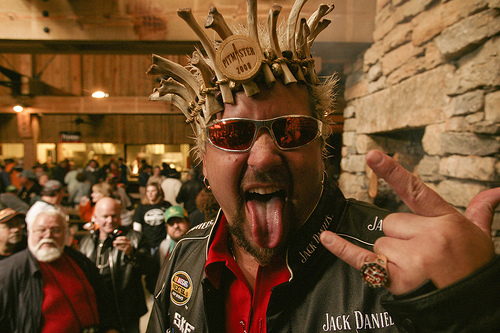
Hey look, it's Guy Fieri.
Deboss-- whose avatar is an anime girl's ass-- is who inspired this blog post. The things Deboss has to say about books are the most insipid things I have ever heard in my life, and the fact that he's allowed to post on a site that supposedly bans people for being too negative is why I decided to highlight the goddamn morons who populate that site's literature discussions.
 "My advice would be to further promote Table Top Games since those require reading and interpretation without all the bullshit that normal literature classes have. Combined with the fact that children are rarely if ever exposed to anything worth reading, it's not surprising that they don't pick it up."
 Deboss thinks that a D&D Player's Manual offers more to the soul than "The Love Song of J. Alfred Prufrock." Deboss is such an idiot that it makes me wonder if his skull is still soft, but then I realize that it must actually be pretty thick because how else do you explain the fact he wasn't aborted?
"Shakespeare was the most unpleasant work I've ever been exposed to. I've seen most of Uwe Bol and Seltzer Burger work, and I'm including it in that statement. Part of the unpleasantness comes from the idea that it's impossible to dislike it, and the answer is greater exposure to Shakespeare. The sooner the works of Shakespeare are forgotten, the better. Given the power, I'd make teaching it a capitol offense."
 Deboss is to literary criticism as John Wayne Gacy was to the world of comedy, and Deboss's posts are to my faith in humanity as John Wayne Gacy was to fifteen-year-old boys. Deboss has a college degree and only books he reads are Animorphs and Star Wars novels-- and he thinks this makes him smarter than the rest of us. Deboss is such an idiot he can't even manage to be illiterate correctly. The process by which his brain tries to shit out intelligent thought most closely resembles a botched suicide.
  
Deboss thinks this should be taught in schools and Orwell shouldn't.
OK, Shakespeare Should be Safe
Okay, sorry... I went to kind of a dark place there. I'm sure that people like Deboss are just flukes and the fact that they're allowed to post this on a site that bans people who try and point out that anime involving the sex lives of 12-year-olds is creepy doesn't reflect anything on the site's policies or problems. Instead, I'll look up some Shakespeare and watch people refute his points. Everyone loves Shakespeare, there's no way that a site this huge, about narrative tropes, is just an echo chamber for anti-intellectual nerds who hate real art. I'll look up my favorite Shakespeare play and I'll see someone praise it for inventing so many of the tropes that the site is supposed to catalog.Something that'll keep me from turning into Shane McGowan by the end of the night.

Macbeth
"This review focuses on Macbeth, but will also contain my criticism of Shakespeare's works as a whole. Shakespeare makes rational men mad and the greatest of critics weak kneed and fawning. The man is the foremost writer of the english language, and we consider his works to be on the same level as the greats of today. But I ask you this? Why... The plot is simple and the Aesop is dull and cliche, Ambition Is Evil. And the editing is simply awful. Macbeth is full of disappearing characters and dropped plotlines."
GIMME ONE TWO THREE FOUR FIVE SIX SEVEN EIGHT NINE TEN BOTTLES OF GIN.
"I wanted the cool, conflicted Macbeth back, I wanted him to achieve victory over their dull and flat enemies. But instead of making an Anti Villain Shakespeare decided to throw him off the slippery slope to save himself the trouble of making the work complex at all."
You are shitting me. This jackass thinks that Macbeth-- whose biggest character trait was being an easily-distracted dimwit --was a cool conflicted hero? He thinks that the play was trying to teach us one specific, easily-reduced moral? He thinks that a 400-year-old play we only have in copies of copies should be expected to have a tight and flawless structure that can hold up against modern works?

"And I would agree with that this is a character study had his character not been so inconsistent, the man is almost bipolar."
GEE, IT'S ALMOST LIKE HE'S DELIBERATELY WRITTEN TO BE WEAK-WILLED, HAVE POOR SELF-CONTROL, AND LOSE HIS MORAL COMPASS ONCE HE GETS A TASTE OF POWER.
 So What Have We Learned?
Well we learned that the internet is awful. That's a thing we learned.

But seriously though, even though I just picked one play these attitudes are pretty representative of geek/nerd culture. And considering that I spent a ton of time recently playing Shadows of the Damned and Fallout, that's a culture I'm part of.

So consider this my return after the hiatus of moving and getting set up in a new/old town. I'm back and I'm gonna keep fighting to talk about how classic, serious literature is cool and relevant and actually pretty fuckin' good, not just Important. Because, to quote Tony Hoagland (probably America's best contemporary poet, who of course has no TV Tropes page because there are no lasers in his works)
But I hate those people back
from the core of my donkey soul
and the hatred makes me strong
and my survival is their failure.

Friday, June 17, 2011

3 Great Books by my 3 Favorite Songwriters

Oof. Been doing a fair bit of hard work recently-- reading Foucault's Pendulum (which I am loving) and packing up my tiny apartment for a move this weekend. I'll probably take the next post off because of the latter-- look for your update around Thursday of next week or so. It'll probably be about Faulkner.

So what I am doing is listening to a lot of Leonard Cohen. New Skin For The Old Ceremony is definitely in my top-5-all-time-favorites list of albums. And it's been thunderstorming all day. And I just had a great dinner with a dear friend. So here's kind of a fluff list while I take it easy at the end of the day. Three of my favorite songwriters each happen to have a novel or two to their name. And they're all really fantastic books. I'd definitely advise you to pick them up.


Master of Reality, by John Darnielle
Yes, this is the umpteenth Darnielle shout-out on this blog. Deal with it.
Deal with it.
Master of Reality is a beautiful, beautiful book. It takes the form of the journal of a 16-year-old boy, who is writing said journal because the doctors at the mental institution he is in require it. They've locked him up, they've taken his shoelaces away, but worse-- they've taken his Walkman and all his Black Sabbath cassettes. So for the course of 100 pages, he describes what Sabbath's 3rd album, Master of Reality, means to him, how much it saves him and provides a reassurance of his humanity, in a desperate attempt to give his tapes back.

It's simple and it's powerful and it's true-- up until the release of We Shall All Be Healed, Darnielle worked as a nurse in a mental institution for young men. There's so much love in this book for the main character, so much contempt for the people who don't recognize the healing power of angry, bitter art. The voice of our narrator in particular is real and powerful, and I can't help but tremble sometimes at how much it made me think of the most miserable parts of my teenage experience. Besides the terrible haircut, I mean. It's about being 16 or 17 and getting up close and personal with the demons that are going to be inhabiting you the rest of your life, and about how Tony Iommi's guitar is sometimes the best weapon at hand for beating them into submission.
Pictured: the brightest light in the world.
I reread it recently during the hour of waiting around before my college graduation. It's 100 very small pages but it is still a pretty hard book to read at times.

And the Ass Saw The Angel, by Nick Cave
When I handed this book to my girlfriend and had her read the scene in which the main character, Euchrid Eucrow, is birthed with a dead twin in the back of a rusted-out car and sterilized with moonshine, her comment was "oh my god, it's like all the subject matter of Faulkner and O'Connor but with the  language of Marquez!" And that's why you should read And the Ass Saw the Angel (and why I should marry this girl someday, but that's neither here nor there).
"If you need more incentive, consider that I have a large collection of rocks, and some of 'em are killin' rocks."
If you've listened to any of mid-80's Nick Cave (and if you haven't, go get a copy of Tender Prey immediately and make peace with your God before you listen to it), you know what to expect: blood, God, the Bloodgod, God's Blood, whiskey, madness, whiskey-madness, and fire. The main character is a schizophrenic mute living with two abusive parents (his mother beats him for not speaking, his father catches animals in homemade traps and makes them fight) on the edge of a religious community in the Deep South.

It treads a line between the Southern Gothic and Magical Realism-- think the lush textuality of Chronicle of a Death Foretold, the heat and the language of Absalom, Absalom!, and the shimmering madness of Wise Blood. It's definitely not a perfectly-constructed book (Cave was on a lot of heroin at the time and would usually write until he passed out facedown on the typewriter), but there's a relentless heat and force to it and the savage inevitability of its violence. It's also a beautiful spectacle, watching an Australian junkie living in London write about a South he only knows through Faulkner novels and bizarre stories.
"Wait, Mississippi's a real place?"
Beautiful Losers, by Leonard Coehn
This one's kind of cheating: one, unlike the other two, Cohen was actually a novelist and a poet before he became a musician, and two, it's a much better-known book. Still though, it's a pretty astonishing and emotionally raw novel and it would be unfair to leave it out. Also, I can't have a list with just two points.

I would say that Beautiful Losers is about sex and Judaism, but, c'mon. It's Leonard Cohen. You know it's about sex and Judaism. So it's also about a love triangle between our narrator, his wife (who he fetishized because he was an anthropologist who specialized on her tribe), and their mutual friend and lover F. Its language is and rich and raw as anything else Cohen wrote, and the characters as wry, bitter, and loving as those of his songs.
Not a particularly cheerful guy, as it turns out.
Beautiful Losers is about that wonderful drive towards self-immolation, the human need to burn away all our faults and become that which we love. It's incredibly Cohen-ish, touching on all those moments in his song where the individual strives to destroy itself with sex and G-d and passion-- think of the opening of "The Future" or all of "Who By Fire." If you like those songs (and if you don't then why the hell do you like me?), this is a book that'll hit you like a speeding car.

Sunday, June 12, 2011

REVIEW: What I've Been Reading Lately

So this one'll be kind of oddball. I've been doing a lot of reading the past couple weeks, but none of the books has been as strange/wonderful or as perfectly fitting as most of the books I try and dedicate a full column to. But, not wanting to let all that reading go to waste, I still want to talk about them briefly. So instead (and, in part, inspired by the fact that my girlfriend got my Nick Hornby's Shakespeare Wrote for Money, which does the same thing), I thought I'd just do some short rundowns of the stuff I've been going through recently.

(Proper article next time, though. Either "3 Great Novels Written by Musicians" or an in-depth author profile).

The Way of All Flesh, by Samuel Butler
This book is... different. It's intensely Victorian, like the ink was made from tea leaves and meat pie filling. However, one gets the feeling that, like Alasdair Gray's Poor Things or Alan Moore's From Hell, it's immersing itself so perfectly in the Victorian age in attempt to show the real Victorianism.
Just hollowed the old broad out and wore her as a suit.
The Way of All Flesh is ostensibly about the young man Ernest Pontifex and how he became a good, non-religious freethinker and charming gentleman just like Butler himself. The fact that the last 70 pages or so are about that makes me pretty sure Butler wanted us to take away that message. However, the real story-- the one that is far more emotionally powerful and forms the best parts of the novel --is Ernest's relationship with his abusive, overbearing father. Butler does an incredible job of showing the kind of power that a dominant parent can have over their child, and the scenes between Ernest and his father are far and away the most intense of the book.

Butler also does a great job of really digging into the roots of Ernest's father's cruelty, both in showing the origins of his need for power and constant affirmation of his importance (a childhood spent in the shadow of his own father, never having the courage to challenge those who were not dependent on him) and the reason's for his wife's meekness and the absolute need she has for her husband's happiness. Butler also ties these beautifully with Victorian ideals, making it absolutely clear that this domestic tyranny and cruelty is a natural extension of Victorian moralism and the sense of obligation.
"Have I mentioned that Jesus was a lie?"
The ending goes on for too long as Butler tries to make the story about religion and society instead of a fucked-up family-- if a good chunk of Ernest's college years had been removed, and the actual ending had been the moment where Ernest finally tells his parents that he doesn't need them and they have no right to control him, it would have been a much stronger book --but it's still a pretty great novel, and has some incredibly powerful moments in it.

The Wasp Factory, by Iain Banks
Okay, I'm torn with this book. I really, really enjoyed it while I was reading it-- I picked it up at 11 at night, read the first 2/3rds, went to bed, and finished it immediately upon waking up --but I'm a little hesitant to wholeheartedly recommend it. In part because I'm not sure I want to go on record as having liked it.

The Wasp Factory contains some of the most brutal, fucked-up content I've ever read. Our narrator, Frank, is a teenage sociopath living on the West Coast of Scotland, getting drunk, killing animals, arranging their skulls on sticks along invisible ley lines, and reminiscing about the three children he murdered when he was younger.
Why are there people like Frank?
I don't mean to imply that it's just shock value, Bret Easton Ellis / post-Invisible Monters-Palahniuk style. This is a very, very good book. One of the most horrifying aspects of it is that we come to understand Frank's logic and, while never feeling that his acts of evil are right, the audience is able to see his rationale and understand the logic by which his world operates. At its core, I think it's a book about adolescence: to be 16 is to be creating a set of rituals, codes, and totems that are exclusive to you alone, and Frank, violent and brutal though he is, is trying to do this without the tools to do so in a way that prevents his rituals from being bloody and savage. He never takes joy in the three murders he committed, but recognized them as necessary acts for the pattern he sees in the world that no one else does. I mean, I just listened to a lot of Raw Power and took up the guitar, but the principle's the same.

That said... I'd be careful with this book, if I were you. It may be understandable and ring uncomfortably true, but it is still a brutal, brutal novel. I'm not even going to describe any of the most chilling scenes in it because I don't want to be responsible for putting them in your head. Just know that, if you do read it, there is a reason behind all of it and it does have a point. And it's a book you will almost certainly tear through in a white heat and be very, very glad to finish.
"I write about spaceships! And five-year-olds being blown to pieces!"
Wigfield: The Can-Do Town That Just May Not, by Stephen Colbert, Amy Sedaris, and Paul Dinello

Several years ago, when the three of them were all just starting out as actors, the authors of this book did a TV show. It ran from 1999 to 2003. It was a parody of after-school specials called Strangers With Candy, and it was wonderful: surreal, strange, and operating by its own beautiful, inexplicable logic. It was easily one of the best TV comedies of all time and it's astounding that something as dark and weird as it ever made it onto television in the first place.
The character on the right never moves on camera and always makes that face.
Wigfield, their print follow-up, is not the same level of brilliant nonsense. It's still a damn fine book though.

Wigfield is the story of Russell Hokes, former highway line painter turned writer, who signs a contract to write 50,000 words about the disappearing American small town and rapidly discovers he can neither write about nor care about the disappearing American small town. Hokes's narrative voice is the best part about the book: he's a terrible, terrible writer who thinks he's a great one, and most of the book's best jokes come from his attempts to sound eloquent (and pad his word count), such as his claim that "with the future in my rearview mirror, I set a course for the past," or the fact that you can clearly identify the passages in which Hokes has attempted to use a thesaurus (usually in trying to find synonyms for "small town").

The town Hokes alights in, Wigfield, is "a charming architectural melange, the overall effect being that of a series of children's forts made from stolen highway equipment"-- a hastily-constructed shantytown/trailer park constructed at the base of a soon-to-be-destroyed dam as an obvious insurance scam. The book becomes an absolutely vicious satire on the "small town" and, moreso, on our love for the town. One of the biggest recurring jokes is the moment at which one of Wigfield's vaguely insane residents (there's supposedly a local serial killer, but it could be pretty much any citizen) will say something absolutely horrible, following it with a proclamation of small-town pride. Wigfield is essentially the worst place on earth, and Hokes is able to convince himself, and hopes to convince his reader, that it's "charming" and "quaint" just because very, very few people want to live there.
And then Stephen Colbert is in this picture.
Essentially, if you enjoy Strangers With Candy, or if Tina Fey's and Jon Stewart's endorsements on the back sound like pretty good advice, check it out. Wigfield is fun, weird, and, at times, unspeakably vicious satire. Also, it stops mid-moral because Hokes reaches 50,000 words, which is a pretty beautiful joke.

Tuesday, June 7, 2011

The 5 Most Badass Classic Authors

One of my favorite posts I've done here was my list of The 5 Most Badass Modern Writers. It was a helluva lot of fun to write and research, and I think the end result was pretty freakin' great. That said, though... look, I don't think that we're becoming emasculated by the passage of time or that we need to "reclaim our manliness" or any of that quasi-macho bullshit.

But I do think that, back when everyone knew how to use a sword, there were probably a lot more terrifyingly insane geniuses.
I mean, I'm a Douglas. Clearly, there's been some watering-down over the years.
So with that in mind, here's a companion to this piece: in no particular order, 5 men who lived before the 20th century and were able to totally tear up an age without anesthesia or basic hygiene. They may scare us, but hey, a Ford Taurus would make them puke in terror so at least we have that advantage should they declare war on our modern poets.

Spoiler alert: 4 of these men had sex with men. Ain't literary history fun!